RV batteries, converters and 12-volt power
Orlando owners search for RV batteries, chargers, converters and surge protectors every month of the year. Most 12-volt trouble starts with a battery that is either flat or worn out, and a meter tells you which.
Techs work wherever the RV is parked: campground, storage yard or home.
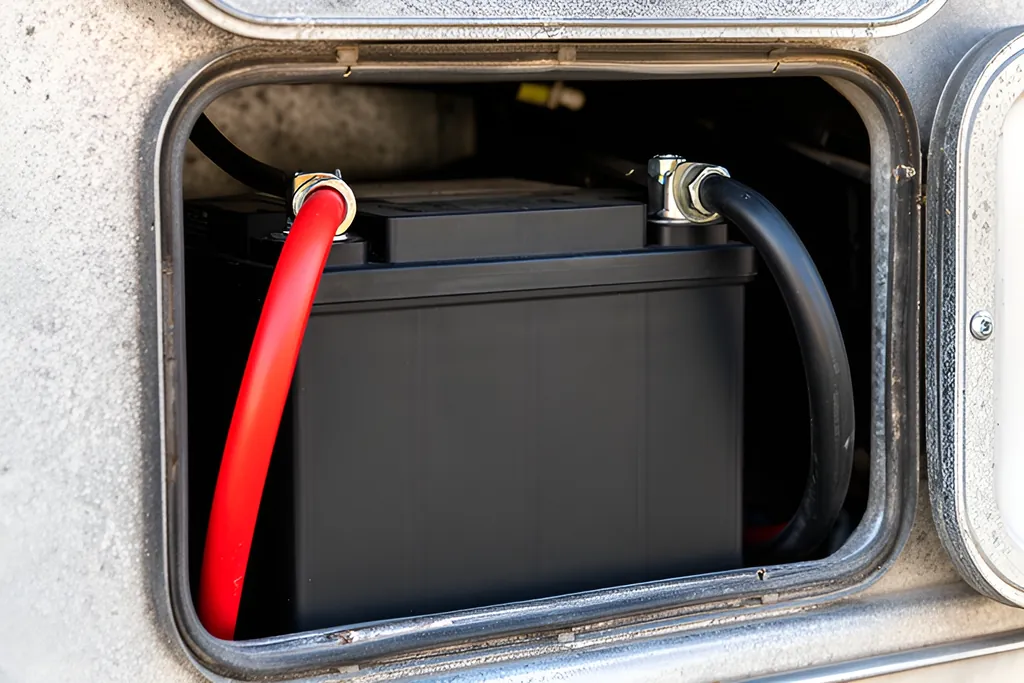
How full is your house battery?
Disconnect the charger and switch off the loads, then let the battery sit. Trojan Battery says to leave it idle for at least six hours, ideally a full day, before measuring. Put a multimeter across the posts and type the reading here.
The answer uses Trojan's published table for flooded lead-acid batteries: 12.73 volts is a full battery, 12.10 is about half, 11.51 is about 10%. Other types use their own charts — for lithium, trust the battery's own monitor or app.
Source: Trojan Battery, “Battery Maintenance”, state-of-charge table for flooded batteries.
Signs of 12-volt trouble
- Dead by morning
Something is drawing power overnight, the charger isn't working, or the battery has lost capacity.
- Fine on shore power, dead off it
The converter is running the lights while the battery itself can no longer hold a charge.
- Slide or jacks crawl
Motors need a lot of current. A tired battery or a loose ground shows up here first.
- Things quit after a storm
A nearby strike or a power surge can take out the converter, a control board or the surge protector itself.
What you can safely look at
- Disconnect switchMost RVs have a battery cut-off switch near the entry door or in the battery bay. Confirm it is on.
- Posts and cablesWhite or green crust on a post blocks charging. Check that the cable ends are tight and not hot after charging.
- Water levelFlooded batteries need the plates covered with distilled water. Sealed and lithium batteries have no caps to open.
- Converter fan and breakerWith shore power connected, you should hear the converter fan or see its light. Check its breaker in the power center.
- Surge protector codeMany surge protectors show an error code after a fault. Note it before resetting; the tech will want to know.

Tech's 12-volt workup
A tech load-tests each battery, measures what the converter and any solar controller actually deliver, and hunts for parasitic draw with a clamp meter.
Typical fixes: new batteries matched to the charger, a replacement converter or charge controller, cleaned and re-crimped cables, a battery monitor, or a change to lithium with charging set up for it.

What 12-volt repairs cost
| Repair | Typical cost | Source |
|---|---|---|
| Electrical repairs, from the base labor charge | up to $2,500+ | Camping World, “Mobile RV Repair Cost Guide”, July 2026 |
| Flooded deep-cycle battery (part) | $100–150 | UDPower, “RV Battery Replacement Guide”, September 2026 |
| 100Ah AGM battery (part) | $175–310 | UDPower, “RV Battery Replacement Guide”, September 2026 |
| 100Ah lithium battery (part) | $300–800+ | UDPower, “RV Battery Replacement Guide”, September 2026 |
Rough 2026 budget only — the tech sets the real price once they see the RV.
Battery figures are per battery and exclude installation. Switching to lithium can also mean a new converter or charge settings.
Figures checked November 2026.
Battery questions
Why does my battery read 13 volts and still die?
A reading taken on the charger, or soon after, shows surface charge. Disconnect, let it rest for hours and measure again; a worn battery sinks fast once it is on its own.
Do surge protectors stop lightning?
No. RV electrical writer Mike Sokol points out that surge protectors and energy management systems do not protect an RV from a direct strike. Unplugging before a storm arrives is the only sure step; see the lightning season guide.
Can I mix an old and a new battery?
Better not. In a bank, the weaker battery drags the newer one down. Replace them as a matched set.
Send your RV problem to a tech
A phone number is enough. A tech with time for the job calls you back.